
Call Now: 0413-2200018 / +91 96770 73462 / +91 80565 55330


The POSH - Pondy Ortho Speciality Hospital
Pondy Ortho Speciality Hospital
Pondy Ortho Speciality Hospital
An elderly osteoporotic patient with a distal femur fracture above a knee replacement — at The POSH - Pondy Ortho Speciality Hospital, Pondicherry, advanced locking plate fixation saved the existing implant and restored mobility.
🦴 View Case Details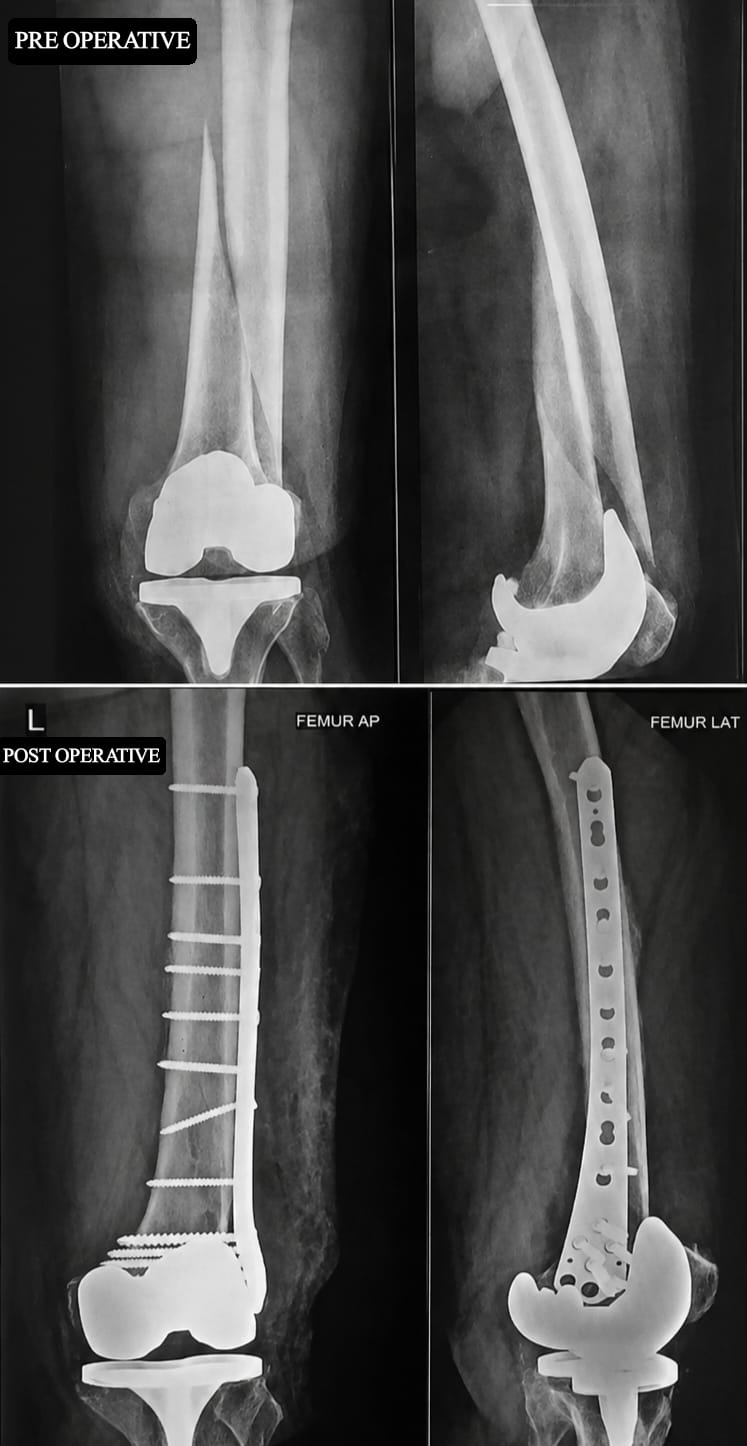 KNEE TRAUMA
An elderly patient with severe osteoporosis presented to The POSH - Pondy Ortho Speciality Hospital, Pondicherry after a fall, sustaining a periprosthetic fracture of the distal femur — a fracture occurring just above a previously performed Total Knee Replacement (TKR).
Periprosthetic fractures around knee implants represent one of the most challenging problems in orthopaedic surgery. The combination of poor bone quality from osteoporosis, the presence of the existing knee implant, and the patient's advanced age created a highly complex surgical scenario. Without proper treatment, such injuries result in prolonged immobility, loss of independence, and life-threatening medical complications.
"Periprosthetic fractures in elderly osteoporotic patients demand specialised implants — standard fixation fails in weak bone. Locking plate technology is the difference between success and failure."
"Post-operative X-rays demonstrated satisfactory fracture alignment and stable fixation. The patient was mobilized under supervision and showed steady progress — returning to daily activities with significantly improved comfort and confidence."
Post-operative X-rays demonstrated satisfactory fracture alignment and stable fixation around the existing knee replacement. The TKR implant was completely preserved — no revision was required. The locking plate provided the angular stability needed despite the poor bone quality, allowing the patient to be mobilised safely under supervision.
The patient showed steady and consistent progress during recovery, regaining mobility and the ability to perform daily activities. This outcome — restoring independence to an elderly osteoporotic patient with a complex periprosthetic fracture — reflects the value of specialised implants and meticulous surgical planning.
Existing knee implant fully preserved — no revision surgery required
Locking plate provided excellent angular stability in osteoporotic bone
Patient mobilised safely under supervision — complications prevented
Returned to daily activities with improved comfort and confidence
This case highlights the importance of advanced orthopaedic techniques in managing complex fractures in elderly osteoporotic patients. Periprosthetic femur fractures above knee replacements cannot be treated with conventional implants — the weak bone will not hold standard screws, and the existing prosthesis limits surgical access.
The specialised locking plate system provided the answer — angular-stable locking screws that grip even in poor-quality bone, and a plate design that can bridge the TKR stem without removing or disturbing the existing implant. With timely intervention and appropriate fixation, this high-risk elderly patient regained mobility and returned to daily life.
"Complex periprosthetic fractures require specialised skills, specialised implants, and the right team. At The POSH, we deliver all three."
At The POSH Hospital, our orthopaedic team specialises in the treatment of complex trauma and revision-related fractures, helping patients — even in the most challenging circumstances — achieve the best possible functional outcomes.
← Back to All Articles